
A factory at Tanjung Langsat is putting up a solar installation on its own ground, and the brief that reached us was not about digging power. The field was already set out. Rows of poles were standing, positions fixed, and none of them could be knocked. Whatever machine came in had to work between them.
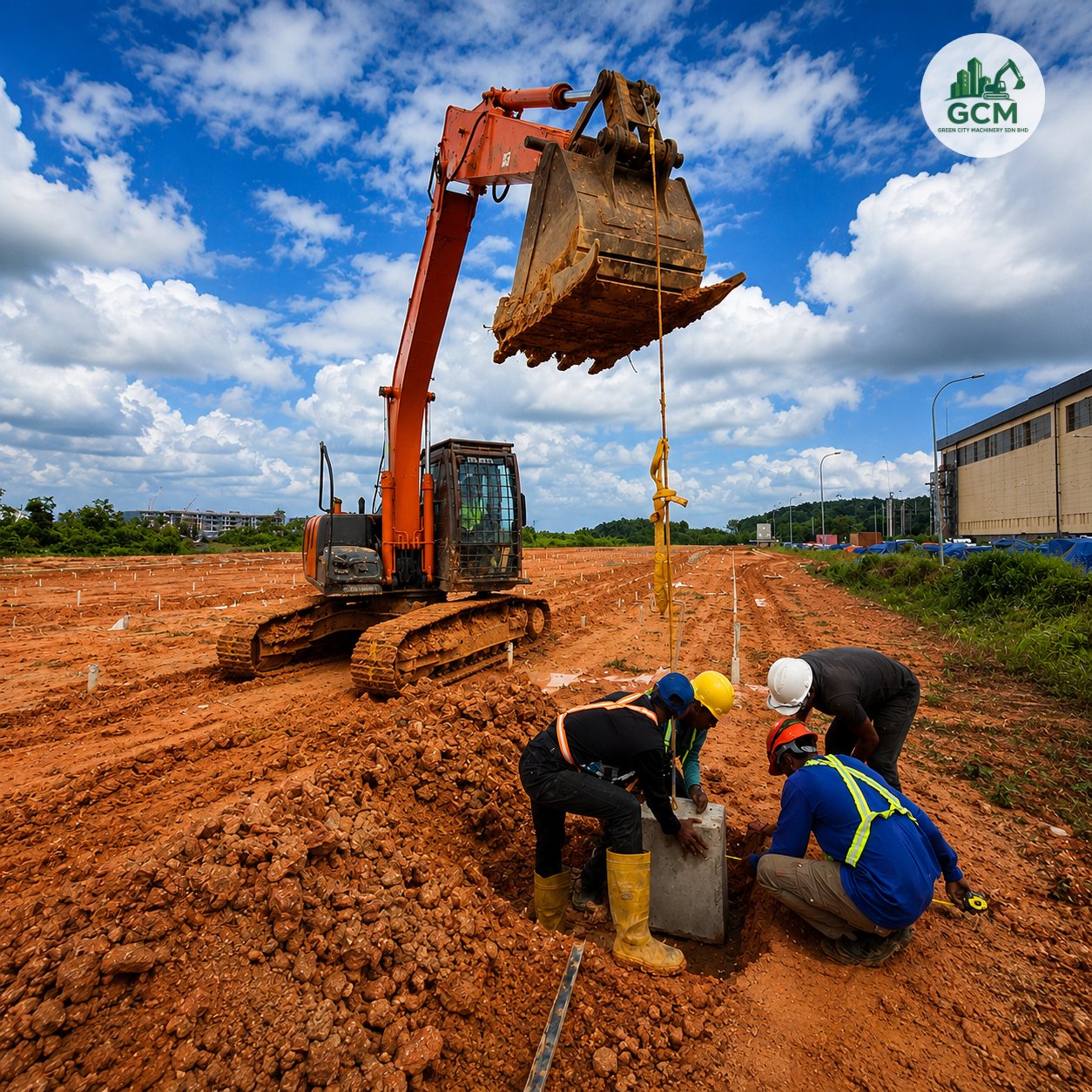
The client had started the footing works with a 20-ton short tail. On paper that is the safe choice: plenty of breakout force for Johor laterite, a short tail so it swings clean. On this site it was simply too big to move around. Every reposition cost time, and time on a solar programme is measured against the panel crew coming up behind you.
On a Solar Field, Split the Work by Mobility, Not by Power
On most earthwork jobs you size the machine by the ground. On a solar field you size it by the gaps. The pole rows fix your working width before you ever look at soil conditions, and a machine that cannot travel the rows without repositioning three times will lose more hours to shuffling than it ever gains in bucket size.
So we sent two machines and split the work by what each one can reach. A new 3-ton mini does the digging, because it is the machine that can actually get to every row. The 12-ton can travel the lines, but once the poles are standing it cannot work its way into every row, so it takes the handling instead: carrying the concrete footings and materials into position, which is exactly what the photo above shows. Both were on site within a short time of the request.
Why the 3-Ton Is the One Doing the Digging
The mini is a Kubota U30-6S: 1,550 mm across the tracks, a 790 mm tail swing radius, 2.82 m dig depth. The width is the number that matters here. It travels a pole row without asking anyone to move anything, it turns in position without swinging into a pole behind it, and rubber tracks let it cross finished ground and access routes without chewing them up. On a field like this, the machine that can get to the work is the machine that does the work.

That does not make the 12-ton the spare. Lifting and placing footings is work the mini has no business attempting, and it is work that has to keep pace with the digging or the whole row stalls. Weight where weight is needed, access where access decides. Neither machine covers this job on its own, which is why the pairing is what we recommend once the poles are already standing. The full job, machine by machine, is written up on our Tanjung Langsat solar project page.
One Call, Both Machines, Both Operators
Both units went out with CIDB / NIOSH / JPJ-licensed operators who work alongside the client’s site team, which matters when the machine is manoeuvring within touching distance of installed poles. Our low loaders are in-house, so delivery timing is ours to control. Mobilisation is usually within 24 hours of confirmation.
Green City Machinery runs 80+ machines across Johor and Malaysia: 3-ton mini, 12-ton, 20-ton, 30-ton and 40-ton excavators, long arm excavators, backhoes, lorry tippers and low loaders, with rock breaker, auger and ripper attachments available for excavator and backhoe work.
Contact us: +6011-105 95686 · www.greencitymachinery.com
Need This Machinery on Your Johor Site?
Operated excavators, backhoe loaders, lorry tippers and low loader transport - delivered to sites across Johor and ready to work the same day.