
12-Ton and 3-Ton Excavators for Solar Farm Footing Works at Tanjung Langsat, Johor
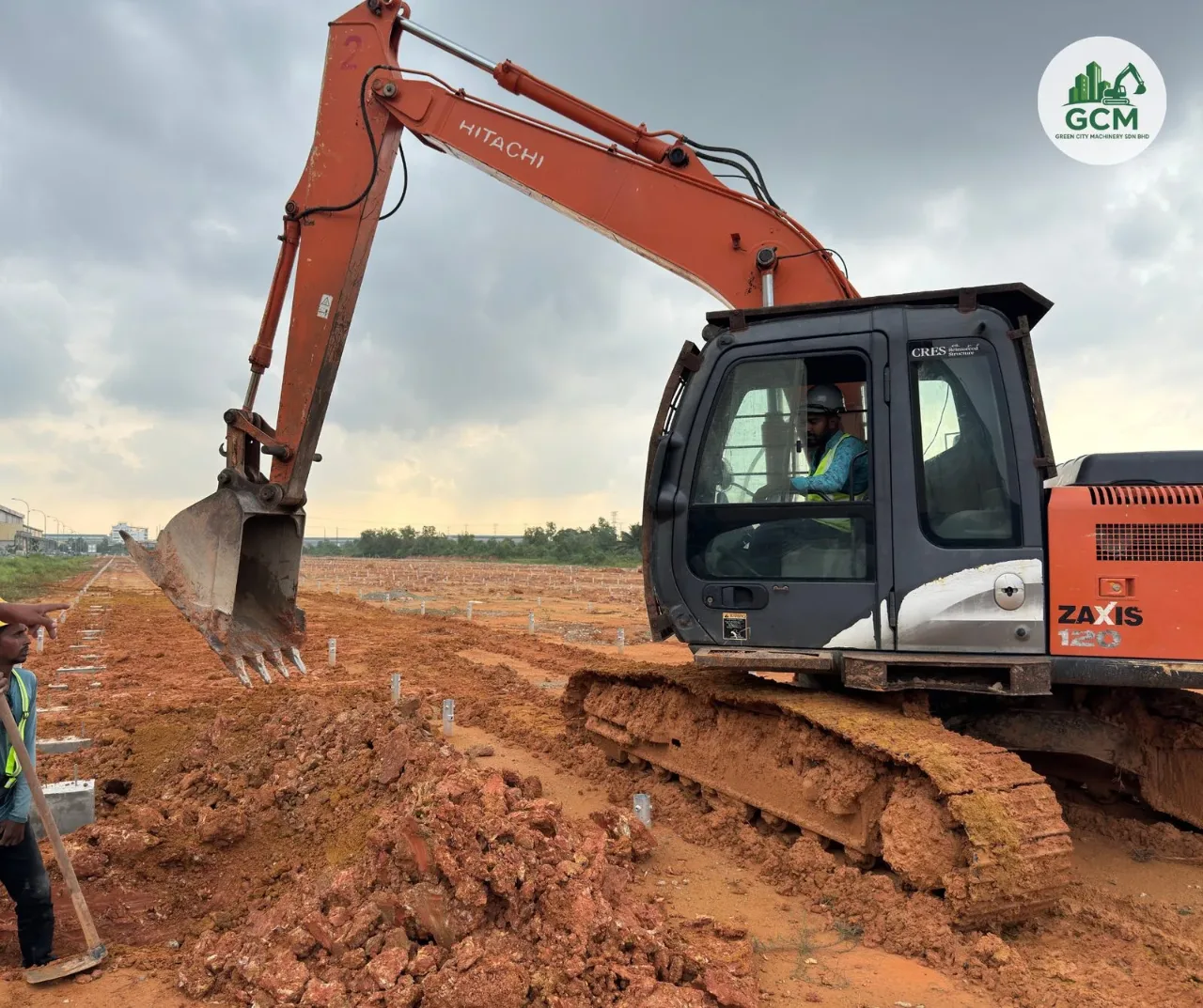
Hitachi ZAXIS 120 and a new 3-ton Kubota mini on footing works between poles that were already standing, on hard laterite ground, with our own operators.
Project Background
Solar farm construction runs on a fixed sequence. The poles go in first, then the footings that carry the mounting structure, then the panels. Every stage waits on the one before it, so footing works that fall behind hold up the entire site.
The site at Tanjung Langsat sits on hard laterite: red, compacted, and unforgiving on a light machine over a full shift. By the time we were called in, every pole was already standing, and the 20-ton short tail the contractor had started with could not move around them. We supplied our Hitachi ZAXIS 120, a 12-tonne machine, together with a new 3-ton Kubota mini and our own operators, on an operated rental basis. Both machines went in at the same time.
The Challenge
- Ground hardness. Laterite is compacted and does not scrape away. Every footing pit has to be cut into it, which is slow going for any machine that is under-weight for the ground.
- Working width. Once the poles are standing, a machine has to reach the work without clipping anything. A 20-ton or 40-ton excavator has the tail swing and track width to make that awkward, and every clipped pole is a cost.
- Sequence pressure. The installation crew follows directly behind the excavator. Any day the earthwork stalls, they stand still too.
How We Worked the Site
The two machines split the work by what each one can reach. The 3-ton mini did the digging, because at 1,550 mm across the tracks it gets to every row. The ZAXIS 120 took the handling, carrying the concrete footings and materials into position, since once the poles are standing it can travel the lines but cannot work its way into every row.
Because the operator came with the machine, there was no learning period on site. Both operators worked to the pole layout, so the contractor supervisor only had to confirm the setting-out rather than direct the machines.
Machine, operator and delivery all came through us. One company to call, one number if anything needs sorting out on site.
Why the 12-Ton Class Fits Solar Work
The 12-tonne class sits in the gap that solar and light infrastructure work keeps landing in. It carries enough breakout force to cut hard ground all day, in a body that still travels the pile lines once they are standing. A 3-ton mini works the tightest rows but cannot hold that output in laterite. A 20-ton is often too wide to be safe around finished poles. That combination is why the 12-ton has become one of the most requested machines on solar sites in Johor.
Different classes are not interchangeable, and they are not priced the same. The right question is never which machine is cheapest, it is which machine can finish the work without damaging what is already built.
Have a Solar Farm or Site Formation Job in Johor?
Tell us the location and the ground condition. We will tell you which class of machine fits, and what it costs to put it on your site.
Contact usCall +60 11-1059 5686