
40-Ton Excavator for Jacking Pit Excavation at Segamat, Johor
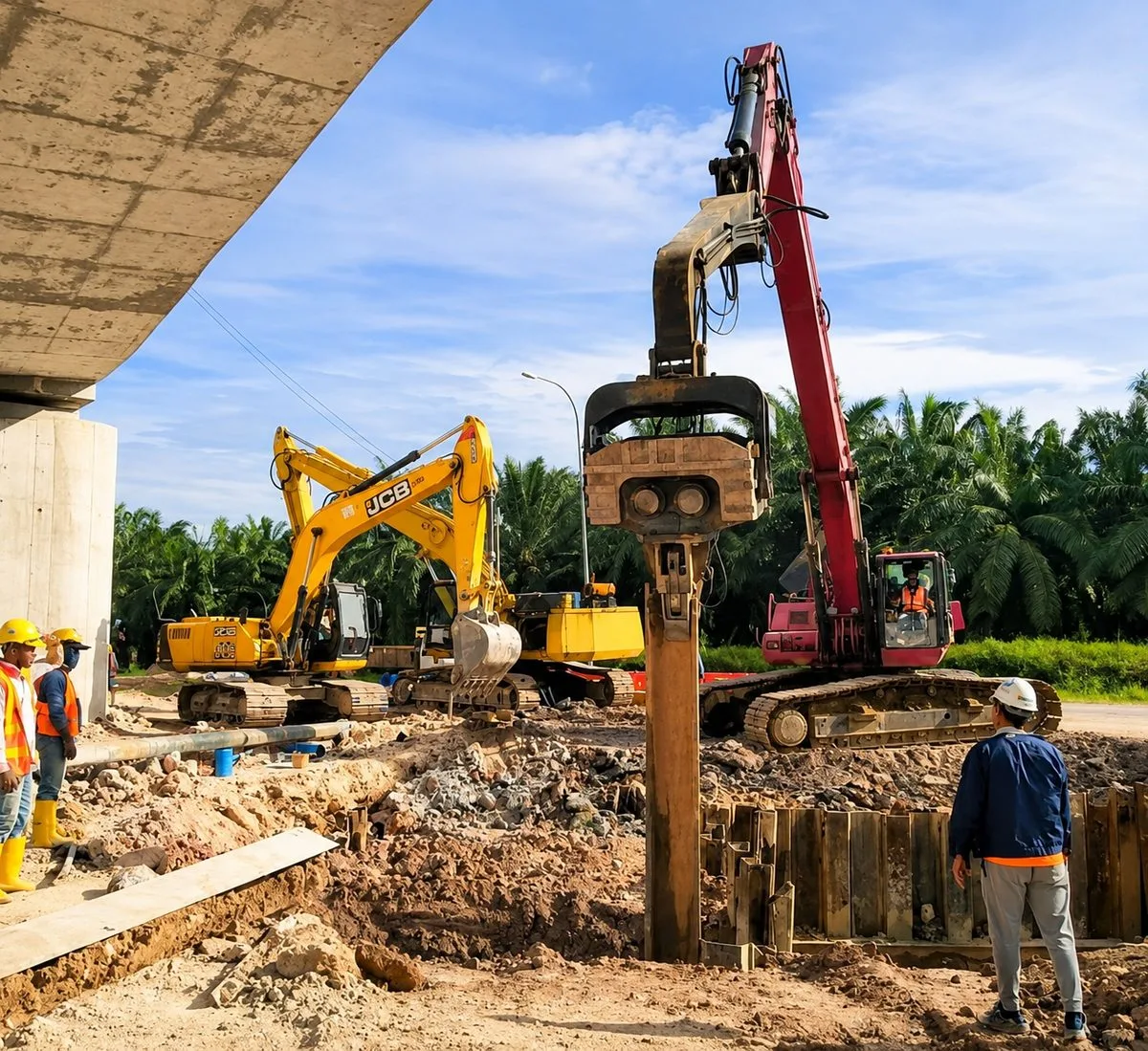
Sheet pile driving and deep pit excavation for a water main diversion under the Electrified Double Track railway alignment.
Project Background
Where the Electrified Double Track railway alignment crossed an existing water main at Segamat, the supply had to be diverted before track works could continue. The contractor chose pipe jacking: pushing the new water reticulation pipe underneath the alignment rather than trenching across it.
Pipe jacking starts with a jacking pit, a deep squared-off excavation large enough to take the jacking rig and the pipe sections, with walls straight enough for the shoring to sit properly against them. That pit is what our 40-ton excavator was on site to build.
GCM supplied the 40-tonne excavator, the vibro hammer and the operator. The pipe jacking itself was carried out by the specialist jacking contractor. We dig the pit they work from.
The Challenge
A jacking pit is not ordinary earthwork.
- It goes deep, and the faces have to stay true. Shoring only works if it sits flat against the wall, so the dig cannot wander.
- Spoil comes out of a confined opening. Everything is lifted vertically out of a boxed pit without disturbing the ground around it.
- The work sits under a live rail alignment. Overhead room is limited, so every swing is planned rather than improvised.
- Two jobs, one machine. Sheet piles had to be driven before the dig started, which means the same excavator had to carry a vibro hammer and then change over to bucket work.
How We Worked the Site
Sheet piles first. The 40-tonne carried a vibro hammer and drove the sheet pile wall that forms the pit box. Once the wall was in, the same machine changed over to a bucket and excavated inside it, lifting spoil out over the pile heads.
Reach at depth is the reason a 40-ton class was specified instead of a 20-ton. In a pit this deep, a smaller machine ends up working at the very end of its range, which slows the dig and makes the bucket harder to control against a face that has to stay flat. Breakout force matters for the same reason: the deeper you go, the less room there is to reposition and try again.
The machine came in on our own low loader and left the same way. Delivery, attachment and operator all came from one source, so there was no coordinating between three suppliers to get one pit dug.
Why This Work Goes to a 40-Ton Machine
Three requirements land in the same place: reach at depth, breakout force in undisturbed ground, and enough carrying capacity to run a vibro hammer on the boom. A 20-ton machine can do any one of those on a good day. Doing all three, inside a boxed pit, under a rail viaduct, is what puts the job in the 40-ton class.
Machine classes are not priced the same, and they are not meant to be. A 40-ton on a job a 20-ton could handle is wasted money, and a 20-ton on this pit would have cost the contractor days.
Deep Excavation or Sheet Piling Work in Johor?
Tell us the depth, the ground condition and the access you have. We will tell you which class of machine fits and what it takes to get it on site.
Contact usCall +60 11-1059 5686